The Science

The Science of NAD+

What NAD+ does in the body, what the newest human research found, and where the evidence stops. Written so you can judge it for yourself — including the parts that don't flatter us.


What NAD+ does

A coenzyme in every cell.

This part is settled biochemistry, not marketing. It describes NAD+ itself — not what any supplement does.

Animated chart: NAD+ levels decline with age, from age 20 to 80. Illustrative, not to scale.
01

It helps turn food into energy

NAD+ carries electrons in the reactions that convert the food you eat into cellular energy. It is used and recycled continuously.

02

Enzymes depend on it

NAD+ is used by enzymes involved in normal DNA repair, and by the sirtuins — a family of enzymes studied in the context of cellular maintenance.

03

Levels decline with age

Published research reports that NAD+ levels decline with age. Measurements vary by tissue and method, so we don't quote a single dramatic figure.

Illustrative representation of the age-related decline in NAD+ reported in published research. Not to scale.

The evidence

Where the evidence stands.

Raising a number in a blood test is not the same as feeling, performing or ageing differently. This is how far the human research has actually got.

NAD+'s role in cellular energy metabolismEstablished

Textbook biochemistry. Describes the molecule, not any supplement.

NAD+ levels decline with ageEstablished

Well documented, though the size of the decline varies by tissue and measurement method.

Precursors (NR, NMN) raising NAD+ in bloodConsistent in trials

Seen across many human trials over weeks to months, including the 2026 studies below.

Oral NAD+ itself raising NAD+Limited data

Very little human data. A 2024 review argues it is poorly absorbed; a registered trial has not yet reported.

Effects via the gut microbiomeEarly research

One 2026 study, partly based on lab experiments outside the body.

Physical performance and muscle functionMixed results

Results differ between trials. The 24-week NMN trial below found no change in physical performance.

Improving cognitive performanceNot established

Most supportive findings so far come from animal research.

Slowing ageing or extending lifespan in peopleNot established

No human trial has shown this. Promising animal results have been hard to reproduce in people.

These ratings summarise published human research on NAD+ and its precursors in general, drawing mainly on the 2026 Ageing Research Reviews systematic review below. They are not results for Apex NAD+ Complex, which has not been the subject of a clinical trial.

2026 research

What the newest studies found.

Every study here used a precursor — NR, NMN or nicotinamide — that the body converts into NAD+. Apex contains none of them. We include this research because it is the bulk of the human evidence in the field, not because it tested us.

Nature MetabolismRandomised trial

The differential impact of three different NAD+ boosters on circulatory NAD and microbial metabolism in humans (opens in a new tab)

Studied: NR, NMN and nicotinamide (precursors — not in Apex)

What they did
65 healthy adults took NR, NMN, nicotinamide or a placebo daily for 14 days.
What they found
NR and NMN raised circulating NAD+ to a similar degree; nicotinamide did not produce a sustained rise. Lab experiments suggested gut bacteria help convert NR and NMN.
What it doesn't show
Any health outcome. It ran for two weeks, the gut findings were partly lab-based, and it was led by Nestlé Research, whose parent company sells NR.
Read the paper → (opens in a new tab)

npj AgingRandomised, double-blind trial

Sustained NAD⁺ augmentation by high-dose nicotinamide mononucleotide supplementation in older adults: a 24-week randomized, double-blind, placebo-controlled trial (opens in a new tab)

Studied: NMN (a precursor — not in Apex)

What they did
62 healthy adults aged 65 and over took 1,250 mg of NMN or a placebo every day for 24 weeks.
What they found
NAD+ and related compounds in the blood rose and stayed raised. The supplement was generally well tolerated.
What it doesn't show
A felt or functional benefit: its main outcome did not improve significantly, and physical performance did not change. The trial was funded by the NMN supplier.
Read the paper → (opens in a new tab)

iSciencePharmacokinetic study

The NAD-brain pharmacokinetic study of NAD augmentation in blood and brain using oral precursor supplementation (opens in a new tab)

Studied: NR and NMN (precursors — not in Apex)

What they did
A small study of 12 adults, half of them living with a medical condition, taking NR or NMN daily.
What they found
Blood NAD took about two weeks to reach a steady level and fell slowly after stopping. How much it rose varied widely from person to person.
What it doesn't show
Any health outcome. It was very small, and was designed to measure how levels change over time.
Read the paper → (opens in a new tab)

Ageing Research ReviewsSystematic review

NAD⁺ supplementation for anti-aging and wellness: A PRISMA-guided systematic review of preclinical and clinical evidence (opens in a new tab)

Studied: NR, NMN and related compounds (precursors — not in Apex)

What they did
Reviewed 113 studies published between 2010 and 2025: 33 in people and 80 in rodents.
What they found
In people, oral NR and NMN consistently raised NAD-related markers and were generally well tolerated over weeks to months.
What it doesn't show
That this translates into health benefits. Effects on functional, metabolic and vascular outcomes were mixed and often null; the authors call clinical effectiveness for anti-ageing or wellness inconclusive.
Read the paper → (opens in a new tab)

The ConversationExplainer

Can supplements containing NMN, NAD+ and resveratrol really slow ageing? Here's what the evidence says (opens in a new tab)

Studied: NMN, NAD+ and resveratrol

What they did
An accessible review of the research behind popular longevity supplements.
What they found
Promising results in mice have been hard to reproduce in people. Resveratrol is not an NAD+ precursor, and human trials have not shown it slows ageing.
What it doesn't show
It is a summary article, not new research.
Read the article → (opens in a new tab)

What this means for Apex

None of these studies tested Apex.

We would rather you understood exactly how this research relates to what's in the bottle than borrow its results.

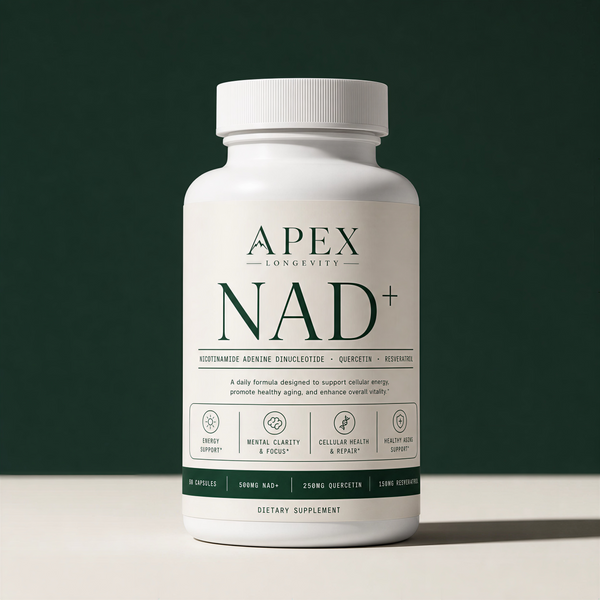
Apex contains NAD+ itself — not NR, NMN or nicotinamide.500 mg of NAD+ per serving, with 250 mg quercetin dihydrate extract and 150 mg Japanese knotweed extract. Research on precursors describes other molecules, so it does not substantiate anything about this formula.

Human research on oral NAD+ itself is limited.A 2024 review in npj Aging argues that oral NAD+ is poorly absorbed. A randomised trial of an oral NAD+ capsule in healthy adults is registered (NCT07692633) but, as of October 2026, has not yet started recruiting. When it reports, we'll say what it found.

Resveratrol is not an NAD+ precursor.Apex includes Japanese knotweed extract, standardised to 98% resveratrol. We don't claim it raises NAD+, and human trials have not shown that resveratrol slows ageing.

Apex has not been clinically trialled.Describing NAD+ itself rather than a precursor is a description of the formula — not a claim that it works better. If that changes, this page changes.

This page is educational and is not medical advice. The studies described are independent, did not test Apex NAD+ Complex, and none of their authors has reviewed or endorsed it. *These statements have not been evaluated by the Food and Drug Administration. This product is not intended to diagnose, treat, cure, or prevent any disease. Talk to your doctor before starting any supplement.