The Science: What We Know and What We Don't
Most supplement science pages are written to sell. This one is written to let you judge. Where the evidence is strong we say so; where it is thin or missing, we say that too — including where it undercuts our own positioning.
What NAD+ does in the body
This part is settled biochemistry, not marketing.
NAD+ (nicotinamide adenine dinucleotide) is a coenzyme found in every cell. It plays a central role in converting food into cellular energy, participating in the redox reactions at the heart of metabolism. It also acts as a substrate for enzymes involved in normal DNA repair, and for the sirtuins — a family of enzymes studied in the context of cellular maintenance.
None of that is in dispute. It is in textbooks.
NAD+ declines with age
Published research reports that NAD+ abundance declines with age. This is an active and well-populated area of study.
What we won't do is give you a single dramatic number. You will often see “NAD+ falls by 50% by age 50” on supplement sites, usually attached to a steep graph. The underlying research is more varied than that: measurements differ by tissue, by method and by population. We removed a chart making exactly that claim from this site, because we could not stand behind the precision it implied.
The honest statement is: NAD+ levels decline with age. That is enough, and it is true.
Is oral NAD+ actually absorbed?
This is the most important question on this page, and the most uncomfortable one for us, because the honest answer complicates our own product.
Most human research on raising NAD+ has not used NAD+ itself. It has used precursors — nicotinamide riboside (NR) and nicotinamide mononucleotide (NMN) — which the body converts into NAD+. Those trials tell you about the precursors. They do not tell you how orally administered NAD+ performs.
Further, a 2024 review in npj Aging argues that NAD+'s instability and poor bioavailability to most cell types make direct oral NAD+ supplementation ineffective. We are not going to hide that paper from you: read it here.
The Cleveland Clinic makes a similar point for a general audience — that NAD is difficult for the body to absorb in supplement form, which is why products typically use precursors, and that long-term benefits and risks remain unclear. Read it here.
There is a registered randomised, placebo-controlled trial of an oral NAD+ capsule under way (NCT07692633). No results have been published. If it reports positively it would be the first real human evidence for oral NAD+; if it doesn't, that matters too, and we will say so here.
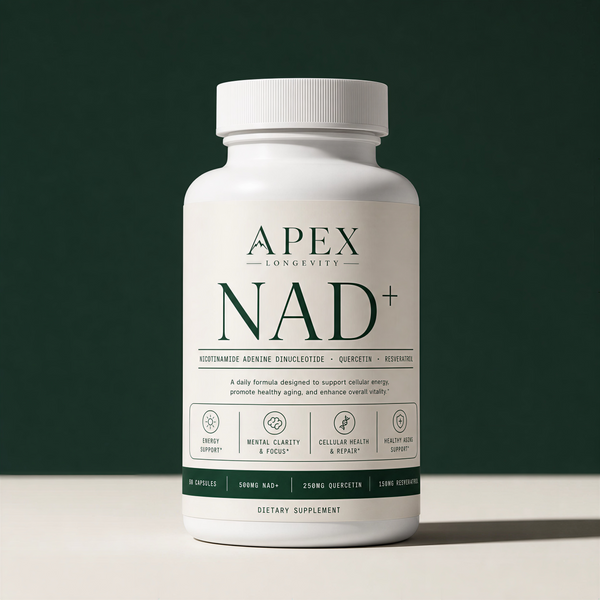
So what does that mean for Apex? Apex NAD+ Complex contains the NAD+ molecule itself rather than a precursor. We state that as a description of the formula — not as a claim that it absorbs better or works better. Some researchers would argue the opposite. We would rather you knew that and chose with your eyes open.
The research on NAD+ precursors
Described here because it is the bulk of the human evidence in this area — and clearly labelled as research on other molecules, not on Apex.
- Martens et al., 2018, Nature Communications — 1,000 mg/day nicotinamide riboside for 6 weeks in adults aged 55–79. Blood NAD+ rose by roughly 60%; well tolerated; exploratory signals in blood pressure and arterial stiffness. Source
- Elhassan et al., 2019, Cell Reports — 1,000 mg/day NR for 21 days in men around age 75. Raised the muscle NAD+ metabolome and lowered some inflammatory markers, but produced no change in muscle function or mitochondrial bioenergetics. Source
- Trammell et al., 2016, Nature Communications — first human pharmacokinetics of oral NR; dose-dependent rise in the blood NAD+ metabolome. Source
- Review, 2022 — NAD+ precursors have not been shown to improve training adaptation or athletic performance in healthy humans. Source
- Review, 2022, cognition — findings are mostly positive but primarily in animal models; properly controlled human research is still needed. Source
- Nature Metabolism, 2025 — a review of NAD+ precursor supplementation in human ageing that directly addresses the limitations of the current clinical evidence and the need for more trials. Source
Note the pattern: precursors reliably raise measured NAD+ in blood or tissue. Whether that produces a benefit you would notice is a separate question, and it is not settled.
Quercetin
Included in the formulation at 250 mg per serving, as Quercetin Dihydrate Extract from Sophora japonica whole flower bud.
Quercetin is a dietary flavonoid. It has been studied in laboratory research as an inhibitor of CD38, an enzyme that metabolises NAD+. That is a mechanistic hypothesis from lab and animal work — it is not evidence that taking quercetin extends the effect of a NAD+ dose in people, and we will not phrase it that way.
The only human trial in the material available to us is in a disease population, which makes it inappropriate to cite on a product page for healthy adults. So we don't.
Resveratrol
Included in the formulation at 150 mg per serving, as Japanese Knotweed Extract (Polygonum cuspidatum, root) standardised to 98% resveratrol.
Resveratrol has been studied as a SIRT1 activator, again largely in laboratory and animal research. Two human studies worth knowing about, both clearly labelled as ingredient research at doses and in populations that are not ours:
- Witte et al., 2014, J Neuroscience — 200 mg/day resveratrol for 26 weeks in healthy overweight adults aged 50–75. Improved word-recall retention and hippocampal connectivity versus placebo. A single study, using synthetic resveratrol at a different dose from ours. Source
- RESHAW trial, JBMR — 75 mg twice daily in postmenopausal women; improved bone density at 12 months. A specific population and a condition-adjacent outcome, which is why we are not drawing a product claim from it. Source
What researchers in the field actually say
Quoted for balance, attributed and linked. None of these researchers has any connection to Apex, and none has reviewed or endorsed this product. They are here because they are the people who know this area best, and several of them are sceptical.
- Dr Samuel Klein, Director, Center for Human Nutrition, Washington University School of Medicine in St. Louis — impressive results in rodents, human data so far weak; not convinced supplements have been studied enough to show benefits outweigh harms.
- Dr Shalender Bhasin, Brigham and Women's Hospital / Harvard Medical School — an attractive hypothesis, but human studies are early and benefits are not yet established in large trials.
- Dr Christopher Martens, Director, Delaware Center for Cognitive Aging Research — his work shows NR can safely raise blood NAD+ within weeks, but the data remain preliminary until replicated in large trials; he has said marketing has got ahead of the science.
- Jacob Hill, ND, Cleveland Clinic — NAD is difficult to absorb in supplement form; research is still developing.
Source: NPR, May 2026
Where that leaves us
Points of agreement across these sources:
- NAD+ is essential to energy metabolism, and declines with age.
- Precursors (NR, NMN) can raise blood NAD+ in humans.
- Precursors have appeared safe in the trials run so far; long-term safety is not settled.
- Health benefits in healthy people are not yet proven in large human trials.
- Independent testing has found label accuracy varies across NAD+ products — which is a good reason to ask any brand, including us, for a COA.
Apex NAD+ Complex has not been the subject of a clinical trial. Research about an individual ingredient is not evidence about a finished product. If that changes, this page changes.
*These statements have not been evaluated by the Food and Drug Administration. This product is not intended to diagnose, treat, cure, or prevent any disease. Individual results vary. Talk to your doctor before starting any supplement.