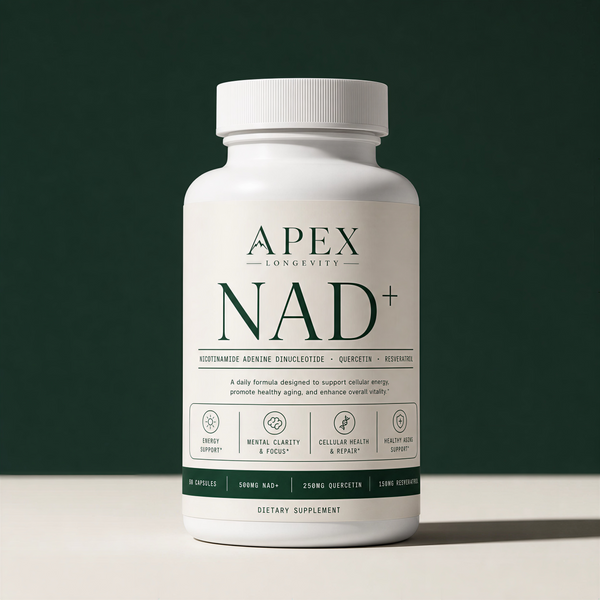
NAD+ (Nicotinamide Adenine Dinucleotide)
Dose in Apex Nº001: 500 mg direct NAD+ per 2-capsule serving.
What NAD+ is
NAD+ (nicotinamide adenine dinucleotide) is a coenzyme found in every living cell. It is not a vitamin, a stimulant or a hormone — it is a molecule your cells use to carry out two fundamental jobs: transferring electrons during energy metabolism, and acting as a substrate for a family of enzymes involved in cellular maintenance and repair signalling.
In practical terms, when your mitochondria convert food and oxygen into ATP (the energy currency of the cell), NAD+ is one of the carriers that makes that reaction possible. It is consumed and recycled continuously.
Why it is discussed in longevity research
Two things make NAD+ a focus of ageing research. First, it sits upstream of a very large number of cellular processes, so its availability is relevant to many systems at once. Second, published research indicates that tissue NAD+ levels tend to be lower in older adults than in younger adults. That observation — a naturally occurring decline with age — is why NAD+ became a subject of interest in the healthy-ageing field.
It is worth being precise here: the observation that levels decline with age is well documented. What each intervention does about it in humans is a separate and less settled question. We address that below.
Direct NAD+ versus precursors (NMN and NR)
Most supplements in this category do not contain NAD+. They contain a precursor — commonly nicotinamide mononucleotide (NMN) or nicotinamide riboside (NR) — which the body converts into NAD+ through the salvage pathway.
Apex Nº001 uses the finished coenzyme itself. This is a factual difference in the raw material, not a claim of superior outcomes: we are describing what is in the capsule, not promising it performs better than a precursor in your body. Head-to-head human comparisons of direct oral NAD+ against NMN or NR are not something we are aware of at a standard that would let anyone make that claim honestly.
Why 500 mg
We formulate at doses that are meaningful rather than decorative. A great deal of the category ships small amounts of an active so it can appear on a label. Our position is that if an ingredient is worth including, it is worth including at a level that reflects how it is actually studied and used. 500 mg is a substantial, clearly disclosed dose, and it is printed on the Supplement Facts panel rather than hidden inside a proprietary blend.
What the evidence does and does not show
We think it matters that a longevity brand is straight about this, so:
- The biochemistry of NAD+ — its role in energy metabolism and as an enzyme substrate — is established science, not a marketing claim.
- The age-related decline in NAD+ levels is well described in the research literature.
- Research on supplementing to influence NAD+ status in humans is an active and growing field, and much of it has been conducted on precursors rather than on direct oral NAD+.
- Apex Nº001 itself has not been the subject of a clinical trial. Evidence relating to an individual ingredient is not the same as evidence about this finished product at these doses in this combination, and we will not present it as though it were.
If that changes, we will publish it here with the study attached.
Common questions
How much NAD+ is in Apex Nº001?
500 mg of direct NAD+ per 2-capsule serving, disclosed on the Supplement Facts panel.
Is NAD+ a stimulant?
No. It contains no caffeine or stimulants.
When should I take it?
Two capsules daily with water, or as directed by a healthcare professional. Most people take it in the morning as part of a consistent routine.
Is this the same as NMN?
No. NMN is a precursor the body converts to NAD+. Apex Nº001 contains NAD+ itself.
Also in the formula
Apex Nº001 also contains 250 mg Quercetin Dihydrate and 150 mg Japanese Knotweed Extract standardised to 98% trans-resveratrol. See the full formulation on the NAD+ Complex product page.
*These statements have not been evaluated by the Food and Drug Administration. This product is not intended to diagnose, treat, cure, or prevent any disease.